
GoldHot
GoldHot

직접 연락처

redowan@gh-goldenhot.com+86 188 2417 8258 · WhatsApp로그인 · 구매자 포털
Towel Warmer Warranty & After-Sales Service from a China Manufacturer
Wholesale · June 2026 · 8분 분량

Towel Warmer Warranty & After-Sales Service from a China Manufacturer

A towel warmer warranty china manufacturer offer should cover the heating element 5 years and ship spare parts in 7 days. Here is what real cover looks like.

A towel warmer warranty china manufacturer offer should cover the heating element for 5 years and the shell for 10, ship spare parts in 7 days, and stand behind a written RMA process — anything less means the importer is the warranty. The post-sale layer is where China-sourced bathroom electrics earn or lose the relationship. Here is what real cover looks like, what to write into the contract, and how to verify it before the first PO.

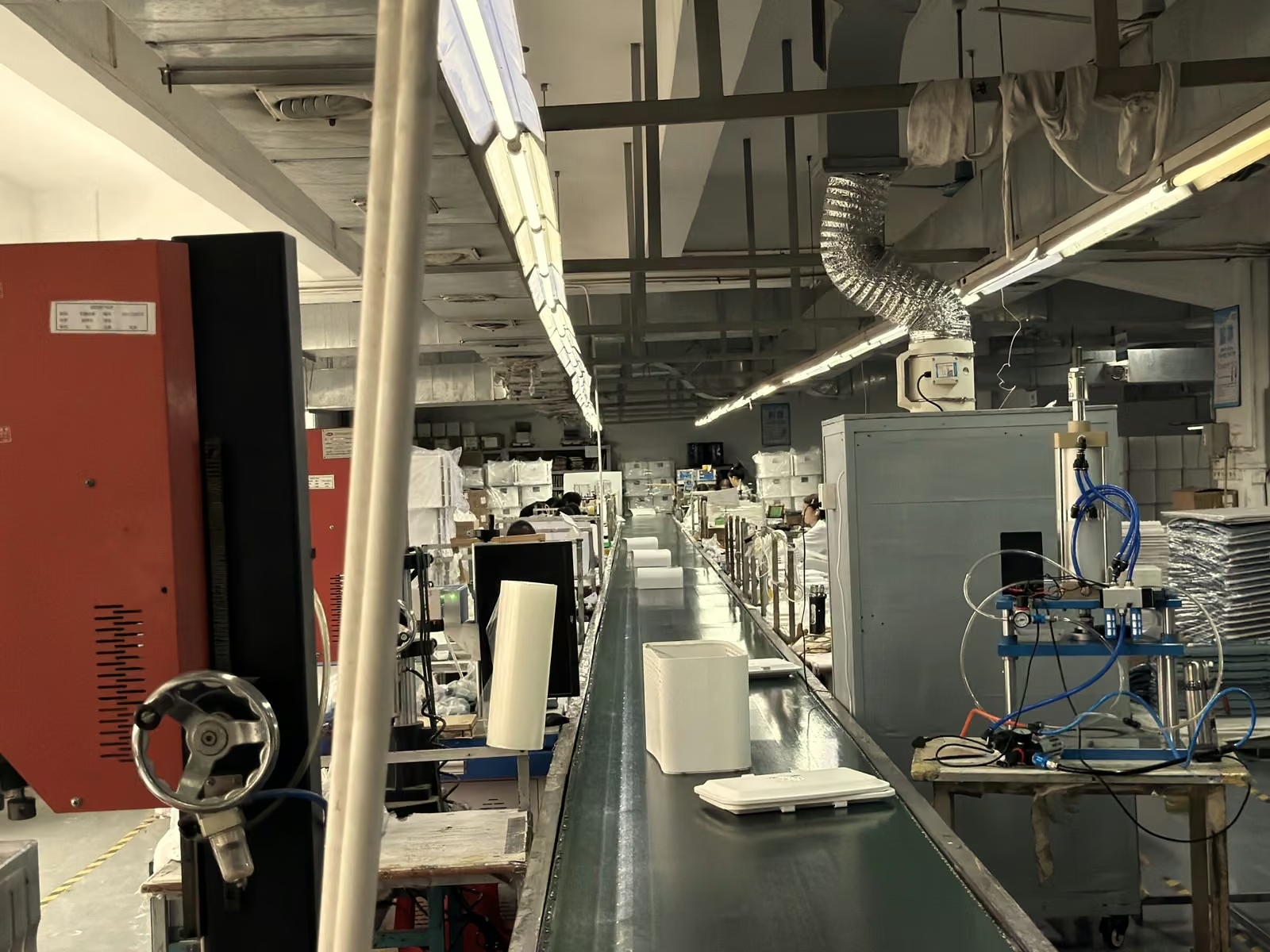
A towel warmer warranty china manufacturer after-sales service line — final QC conveyor at the Dongguan factory

What a real warranty covers

Specifically, a credible heating element warranty on an electric towel warmer separates three layers and states the cover on each:

  • Heating element and thermostat — 5 years minimum on a residential SKU, 3 years on hospitality (heavier use). This is the wear part; if the warranty here is shorter than 3 years, the unit is built for a price point, not a service life.
  • Electronic control board and smart module — 2 to 3 years, with firmware update support for the same period. The smart layer is the next-most-likely failure mode after the element.
  • Shell, frame, and finish — 10 years on 304 stainless, 7 on 201, 5 on powder-coat or brass-coated. The shell rarely fails outright, but the finish warranty matters in coastal and high-humidity markets.

Defect rate and MTBF — the underlying numbers

Meanwhile, the warranty is the contract; the defect rate and MTBF are what actually predict whether you will need to claim it. A credible Dongguan factory line for electric towel warmers runs at a 0.4 to 0.9 percent first-year field defect rate when shipping ETL/UL/CE certified product. Mean time between failures (MTBF) on the heating element runs 35,000 to 50,000 hours, equivalent to 8 to 12 years of typical residential duty cycle. Ask a prospective supplier for the actual figures from their last 12 months of warranty returns; a credible answer is specific, an evasive answer is a flag. The factory technical support team should be able to break down failures by mode (element burn-out, control board, finish, shipping damage).

The spare-parts pipeline that decides everything

For example, a distributor or importer servicing 500 units in the field needs spare parts in days, not months. Verify three things before signing:

  • Spare parts SKUs broken out — the heating element, thermostat, control board, end caps, fixings, smart module each available as a stocked part with a unit price.
  • Air-freight pipeline pre-set — a spare-parts pipeline with DHL/FedEx account already on file, so a 5-unit replacement element ships within 48 hours of an RMA approval and lands at the importer's warehouse in 7 days.
  • Service-stock allocation — a written commitment that 1 to 2 percent of the PO ships as service stock at unit cost, replenished on each subsequent order.

The written RMA process

However, the RMA process is where most China-source warranty offers fall apart. A workable RMA spec covers: the photograph and diagnostic checklist the importer submits, the factory response SLA (typical 1 to 2 working days for approval), the replacement-or-credit decision tree, the freight responsibility split (factory pays outbound on confirmed defect, importer pays inbound on out-of-warranty), and the dispute-resolution path. Get this in the supply contract, not a side email. For a distributor support relationship at any scale, the RMA spec is more important than the headline warranty length — a 10-year warranty with no RMA process is worse than a 5-year warranty with a documented one.

What changes when you import from China specifically

In contrast, China-source warranty service carries three structural differences from a domestic supplier. First, the warranty obligation sits with the manufacturer, not the local distributor — the importer becomes the front-line warranty face to end customers and recovers from the factory. Second, the freight cost on warranty returns can exceed the unit value, so most factories ship replacement parts rather than reverse-logistics the failed unit. Third, the time-zone gap means the RMA cycle is 24 hours longer than a domestic equivalent. Build the importer service contract to match: spare parts pipeline pre-stocked at the importer's warehouse, replacement-not-return as the default, and a named technical contact at the factory with a working overlap window with the importer's customer-service team.

How to verify before the first PO

Specifically, the verification work belongs before the PO, not during the first warranty claim. Run four checks:

  • Reference calls — ask the supplier for two existing importer references in your market, and ask those importers about their last warranty experience. The post-sale liability question, asked of a current customer, gets honest answers.
  • Sample unit aging test — run a sample unit on a continuous-on bench cycle for 30 days. Element survival and finish behaviour both show up.
  • Documentation audit — request the warranty terms, RMA process, and spare-parts SKU list in writing. A factory that has these documents has used them.
  • Factory visit or audit — verify the after-sales service team is a real department, not a single sales contact. Walk the spare-parts stockroom.

The total-cost-of-ownership angle

Ultimately, the warranty and service layer changes the per-unit cost more than buyers expect. For a 1,000-unit US importer of US$80-ex-works towel warmers, a 1 percent field defect rate is 10 returns at a fully-loaded warranty cost of US$45 per return (replacement element, air freight, importer service-team time) — US$450 spread across 1,000 units, or US$0.45 per unit. A 4 percent defect rate on a cheaper supplier is US$1.80 per unit, plus the brand damage. The 25 percent unit-cost saving from a cheaper supplier is fully consumed by the warranty cost difference. Model the post-sale layer into the landed-cost calculation.

Frequently asked questions

What warranty should a China-source towel warmer carry?

A credible towel warmer warranty china manufacturer offer covers the heating element for 5 years (3 on hospitality), the electronic control board for 2 to 3 years, and the shell and finish for 10 years on 304 stainless. Shorter cover on the element is a price-point unit, not a service-life unit.

Who handles warranty returns when importing from China?

The importer typically handles the end-customer face, recovering from the factory through an RMA process. Replacement parts ship by air freight rather than reverse-logistics the unit. A 1 to 2 percent service-stock allocation on each PO covers most warranty volume without per-claim freight cycles.

How fast should spare parts ship from a Chinese factory?

A credible spare-parts pipeline ships air freight within 48 hours of RMA approval and lands at the importer's warehouse in 7 days through DHL or FedEx. Spare-parts SKUs (element, thermostat, control board, smart module, end caps) should be stocked, not built-to-order.

What defect rate is normal for electric towel warmers?

A credible Dongguan factory shipping ETL/UL/CE certified product runs 0.4 to 0.9 percent first-year field defect rate. Heavier rates suggest QC gaps or specification-cost cutting. Ask the supplier for actual warranty-return data from their last 12 months.

What should be in the supply contract about after-sales service?

The contract should cover the written warranty terms by component, the RMA process and SLAs, the spare-parts pipeline and freight split, the service-stock allocation, and the named factory technical-support contact. The distributor support layer lives or dies on these clauses being explicit.

What GoldHot stands behind

Ultimately, GoldHot has shipped electric towel warmers from Dongguan since 2009, with a current field-defect rate running below 0.8 percent across the 28-SKU line. The standard warranty covers the heating element 5 years (3 on hospitality), the electronic control board and smart module 2 years, and the 304 stainless shell and finish 10 years. The factory technical support team operates a written RMA process with a 2-working-day approval SLA, air-freights spare parts on DHL within 48 hours of RMA, and ships a 1 to 2 percent service-stock allocation on every PO at unit cost. The line ships with ETL · UL · CE · FCC · PSE · UKCA so the same SKU clears every major importer market, and the 350-plus staff in the 20,000 m² facility include a dedicated after-sales service team available across European, North American, and APAC time zones. For distributors and importers evaluating a long-term supply relationship, the post-sale liability layer is documented and audit-ready, not an afterthought.

End of articleContinue reading