GoldHot
GoldHot

直接聯絡

redowan@gh-goldenhot.com+86 188 2417 8258 · WhatsApp登入 · 採購入口
Smart Home Towel Warmer Integration: Matter, HomeKit, Alexa Compared
Smart Home · June 2026 · 閱讀 8 分鐘

Smart Home Towel Warmer Integration: Matter, HomeKit, Alexa Compared

Smart home towel warmer integration compared — Matter, Apple HomeKit, Amazon Alexa, Google Home. The protocols, the trade-offs, and what to spec for 2026.

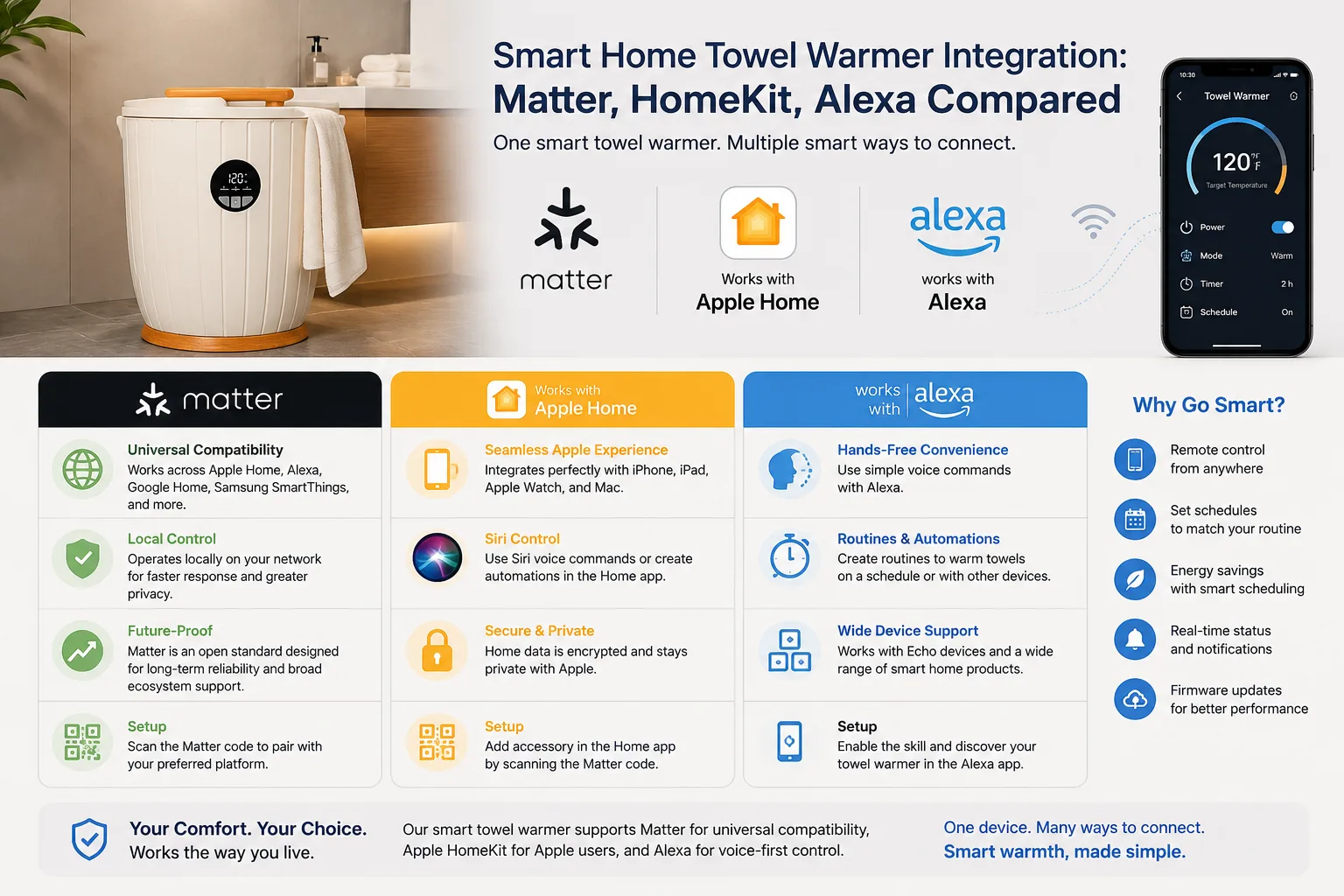
Smart home towel warmer integration in 2026 lives or dies on Matter — a Matter-over-Thread unit appears natively in Apple HomeKit, Amazon Alexa, Google Home, and Samsung SmartThings with no vendor app, and it keeps working when any single platform changes. Everything else — WiFi-cloud-only, Bluetooth, Zigbee — is a compromise. For smart-home retailers, custom installers (CI), and premium home buyers specifying the bathroom, here is the protocol map, the platform-by-platform behaviour, and what to write into the spec.

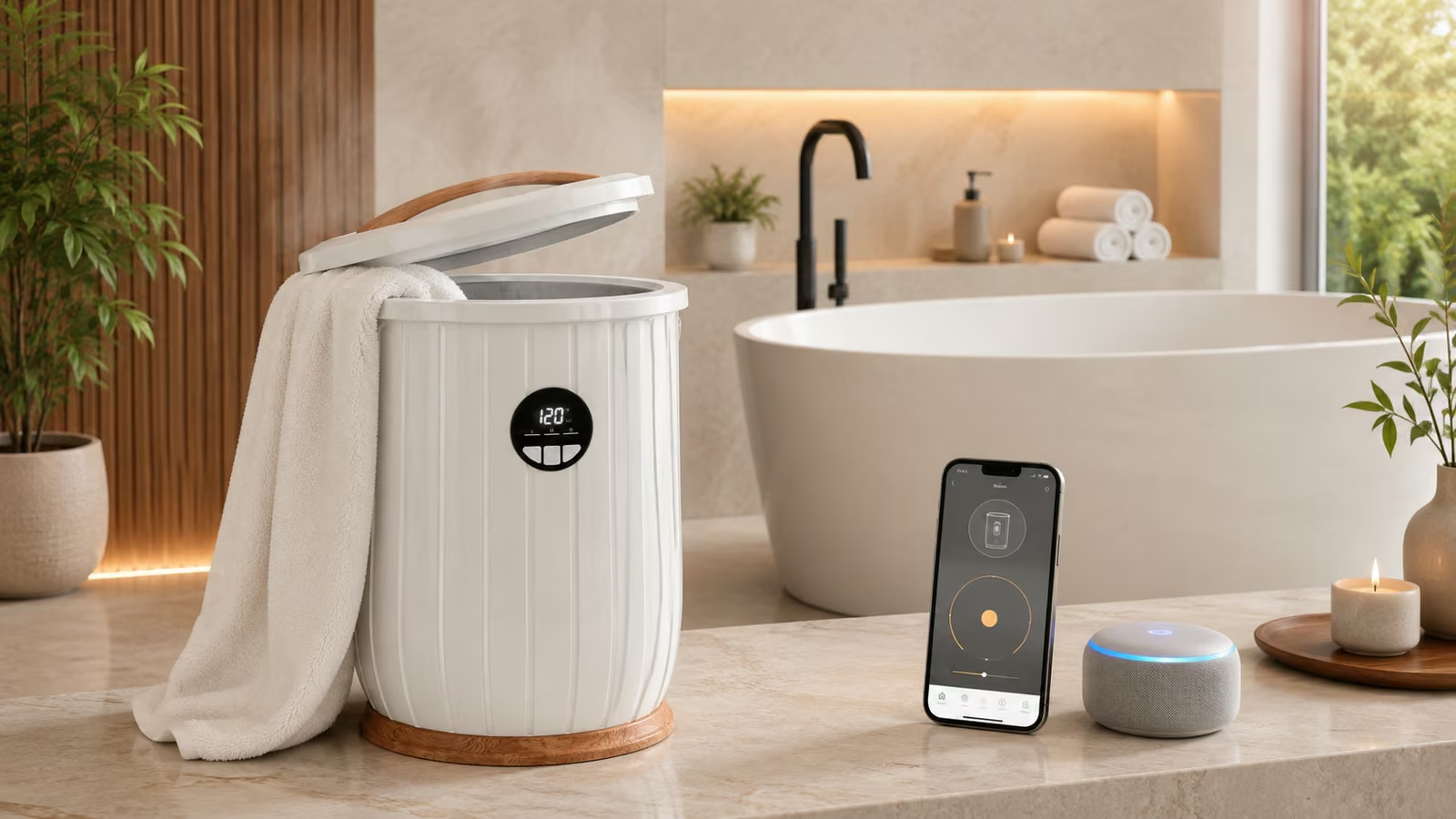
A smart home towel warmer integration with Matter-over-Thread — works natively in HomeKit, Alexa, and Google Home

The protocol stack in 2026

Specifically, four protocols are still in active deployment and the choice between them defines what the bathroom installation can do five years from now:

  • Matter-over-Thread — the 2026 default. Cross-platform, no vendor app required, survives any single manufacturer or platform change. Thread is the mesh radio layer; Matter is the application protocol on top. Most premium hardware is shipping this combination by mid-2026.
  • WiFi (2.4 GHz) — still common, especially on mid-tier units. Works with vendor apps and most platforms through cloud bridges. Downsides: reconnection issues, dependence on the vendor's cloud staying live, and the bathroom WiFi signal often being weaker than the bedroom's.
  • Zigbee — the legacy mesh. Needs a hub (Hue, SmartThings, Aqara). Being superseded by Matter-over-Thread but still installed in many existing systems, and the bridge devices accept Zigbee as a fallback.
  • Bluetooth — short-range, phone-to-unit. No platform integration, no remote control, no automation. Effectively not a smart protocol for a fixed bathroom appliance.

Apple HomeKit — what the integration actually does

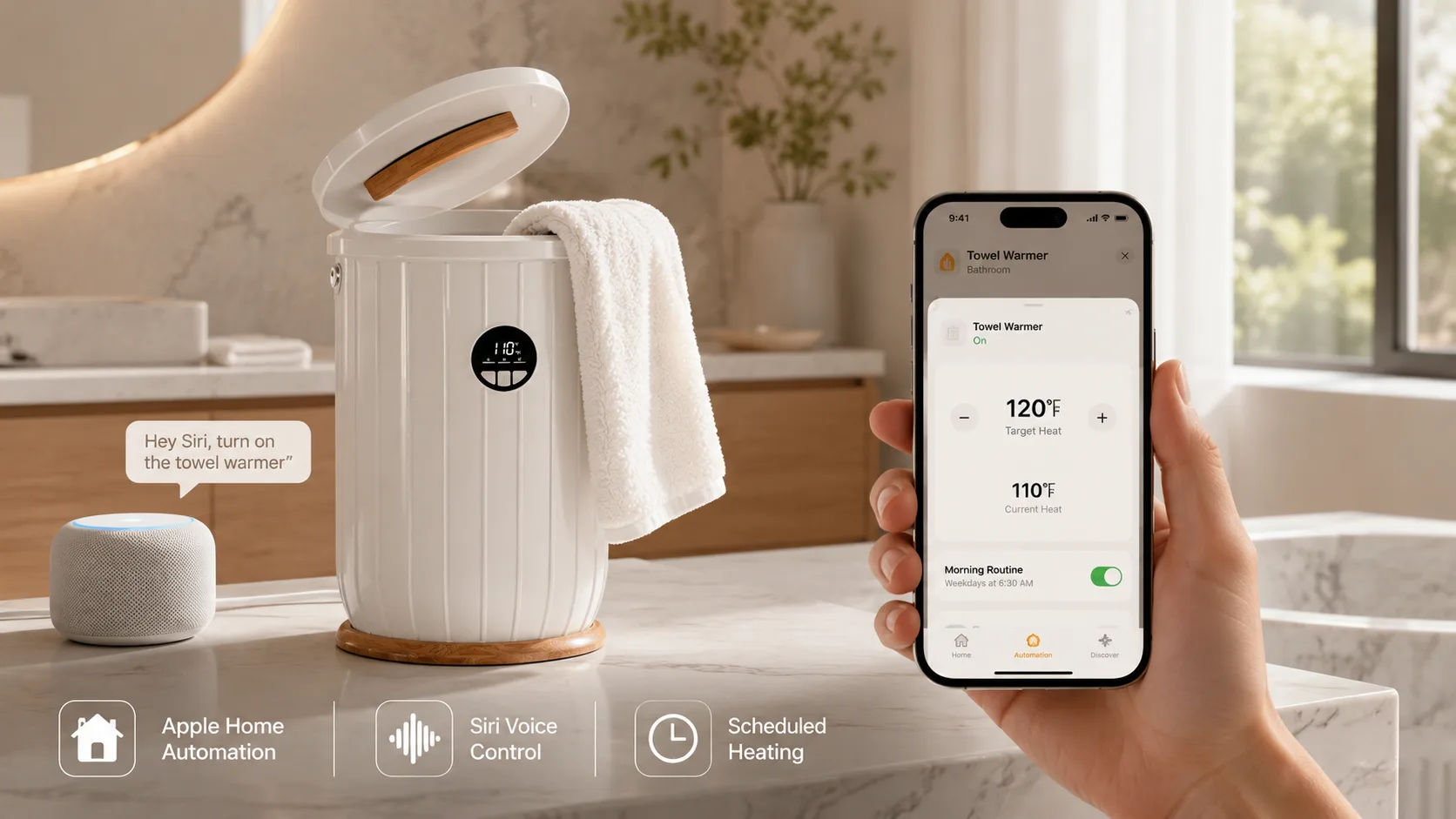
Meanwhile, on Apple HomeKit a Matter-compliant towel warmer appears as a Heater accessory with on/off, target temperature, current temperature, and (on richer implementations) schedule and energy reporting. Siri voice control hits the unit through any HomePod, iPhone, Watch, or Mac. Scene automation lets the rail join a "Good Morning" scene that triggers from the homeowner's first Watch wake or first kitchen-light press. Adaptive Lighting and Adaptive Climate logic does not apply directly to a towel warmer, but the Automations layer handles equivalent triggering. For CI integrators using Control4, Crestron, or Savant, HomeKit appears via certified bridges; for the direct-to-consumer premium home buyer, the integration is set up in the Home app in 60 seconds.

Amazon Alexa — what changes

For example, on Amazon Alexa a Matter or Alexa-skilled towel warmer shows up as a smart heater or thermostat depending on the skill profile. Voice control is identical in capability to HomeKit but spelled differently ("Alexa, turn on the bathroom towel warmer" rather than "Hey Siri, set the bathroom towel warmer to..."). Routines are the equivalent of Apple's Scenes. The Alexa Hunches feature can suggest schedule changes based on usage. Echo Show devices give a visual control surface. In contrast to HomeKit, Alexa is more permissive about non-Matter integration — the vendor-skill route works but degrades when the vendor stops maintaining the skill. Matter via the Echo Hub or compatible Echo (4th gen and later) is the future-proof route.

Google Home — where it sits

In addition, Google Home treats Matter towel warmers as controllable devices with the same on/off, temperature, and schedule surface as HomeKit. Google Assistant voice control runs through Nest speakers, the Nest Hub, Android phones, and Wear OS. Routines provide the scene-automation layer. The Nest Hub Max can show the towel warmer's state as a tile on its dashboard. Google's Matter implementation has matured through 2025 and is solid by 2026. For smart-home retailers stocking the Google ecosystem (Nest, Pixel, Wear), a Matter unit is the cross-sell that doesn't lock the customer into one platform.

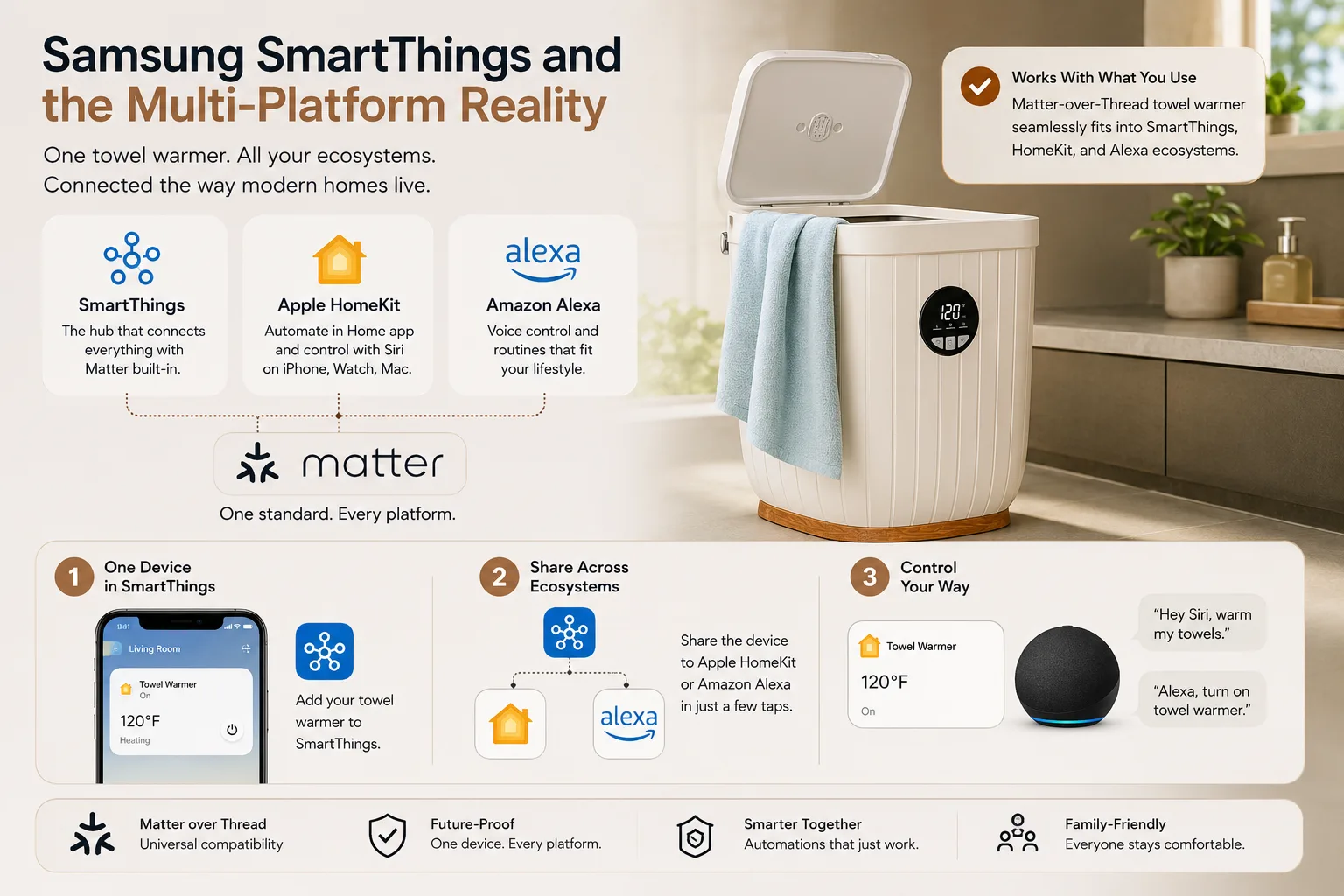
Samsung SmartThings and the multi-platform reality

However, the realistic 2026 home is not single-platform. Premium home buyers and CI integrators typically run two or three platforms — an iPhone household with Apple HomeKit plus Alexa for the kitchen, or a SmartThings backbone with HomeKit on the family's iPhones. Samsung SmartThings is the most platform-agnostic of the major hubs and runs Matter natively. A Matter-over-Thread towel warmer is the only protocol that joins all of these at once without bridges or vendor accounts. This is why Matter, not any single platform, is what to spec.

Scene automation that actually pays for the smart premium

Specifically, the integrations earn their keep through scene automation, not voice control alone. Useful scenes for a smart-home retailer or CI integrator to pre-build:

  • Good Morning — first alarm wake on the homeowner's iPhone triggers a 20-minute towel-warmer pre-heat, bathroom light at 30 percent, and shower-fan ready.
  • Arriving Home — geofencing-triggered pre-heat when the homeowner's phone is 10 minutes from the property, so the rail is warm for a post-commute shower.
  • Guest Mode — the homeowner taps a single button to set towel warmers in the guest bath on a 4-hour pre-heat ahead of an arrival.
  • Holiday Mode — the rail drops to a low-power maintenance temperature on absence detection, returns to schedule on the day before homecoming.
  • Energy Saver — time-of-use mode shifts the pre-heat into off-peak electricity hours where the tariff is variable, saving 30 to 40 percent on running cost.

What to spec for a CI integrator project

Specifically, for a custom-installer building out a US$3M-plus residential project, the towel warmer spec should call out: Matter-over-Thread protocol, native HomeKit and SmartThings certification, energy reporting via the Matter Energy cluster, OTA firmware update support, IP44 or higher ingress rating for bathroom installation, hardwire (not plug-in) electrical connection for clean install, and a vendor with documented 5-year support on the smart module. The brand-name premium for a properly-integrated unit is justified by the integration depth, not the heating element — the element is commodity, the smart layer is what differentiates.

Energy reporting and the Matter Energy cluster

For example, the 2026 Matter spec includes the Energy cluster — the device reports real-time and cumulative kWh use to the home's energy dashboard. For premium home buyers using systems like Sense, Span, or the native Home and Google Home energy views, the towel warmer appears as a line item alongside the dishwasher and EV charger. This matters less for cost (the rail is a US$60 to US$120 a year line) and more for transparency — the homeowner can confirm the unit is doing what was specified, and the CI integrator can flag a unit pulling double its expected draw as a warranty issue before it fails.

What to avoid in 2026

  • Bluetooth-only "smart" units — no platform integration, no automation, no remote control. Not a smart appliance.
  • Cloud-only WiFi without Matter fallback — features die when the vendor sunsets the app. Common on second-tier 2023-2024 stock still on shelves.
  • Proprietary mesh networks — vendor-specific Z-Wave variants and one-off mesh protocols that lock the homeowner in. Matter-over-Thread is the open replacement.
  • Units claiming smart without published app reviews — check the App Store and Play Store ratings before specifying. A 1.5-star review on the vendor app is what the homeowner lives with.

Frequently asked questions

Do smart towel warmers work with Apple HomeKit and Alexa?

Yes — Matter-over-Thread units work natively with Apple HomeKit, Amazon Alexa, Google Home, and Samsung SmartThings without vendor apps. WiFi units work with HomeKit and Alexa through vendor skills or HomeKit bridges, with a degradation path if the vendor sunsets the app. Bluetooth units do not integrate with any platform.

What is the best protocol for a 2026 smart home towel warmer?

Matter-over-Thread is the 2026 default. It is cross-platform, survives any vendor or platform change, integrates natively with every major smart-home system, and supports the Matter Energy cluster for real-time consumption reporting. WiFi is acceptable mid-tier; Bluetooth is not a smart-home protocol.

Can a smart towel warmer join a "Good Morning" scene?

Yes — that is the headline scene-automation use case. Voice control is the visible feature; scheduled pre-heat triggered by the first alarm or geofence entry is where the smart premium pays back. Most platforms ship a pre-built morning routine the towel warmer joins in two taps.

What should a CI integrator spec for a premium home install?

Matter-over-Thread protocol, native HomeKit and SmartThings certification, Matter Energy cluster support, OTA firmware updates, IP44 ingress rating for bathroom install, hardwire connection rather than plug-in, and 5-year vendor support on the smart electronics. The brand-name premium is justified by the integration depth, not the heating element.

Will Matter work with my existing smart home hub?

Most 2024-and-later hubs support Matter — Apple HomePod mini and HomePod (2nd gen), Echo (4th gen) and Echo Hub, Nest Hub (2nd gen), SmartThings Station, and the major CI platforms via certified bridges. Older hubs may need replacement or a Matter bridge. Check the controller's Matter certification before specifying the towel warmer.

What GoldHot ships into the smart-home channel

Ultimately, the GoldHot 2026 flagship smart-home towel warmer integration line ships Matter-over-Thread as standard with WiFi fallback, native HomeKit, Amazon Alexa, Google Home, and SmartThings integration, full Matter Energy cluster support, OTA firmware update through the smart module, and IP44 ingress for bathroom installation. The smart electronics are a configurable layer for OEM buyers, so smart-home retailers and CI integrators can spec their brand on the same hardware platform. Wholesale MOQ is 200 units per SKU, sample lead time 7 to 14 days, production 25 to 35 days. The line carries ETL · UL · CE · FCC · PSE · UKCA so the same smart SKU clears North America, EU, UK, Japan, and APAC markets. The Dongguan factory has been building electric towel warmers since 2009, with 350-plus staff across the 20,000 m² facility producing 28 SKUs into 30 markets. For CI integrators and smart-home retailers, the account team can ship a Matter sample unit pre-paired with a HomeKit and SmartThings test rig within 14 days for evaluation.

End of articleContinue reading