
中国直営のタオルウォーマー製造業者:取引会社を避ける7つの理由
中国製のタオルウォーマー、直販工場: ドンゴアンのメーカーから購入する7つの理由、トレーディングデスクから購入する代わりに12-22%のマージンで再販売されるのではなく。
<>
<2>Why the trading company exists in the first place
<>Most Alibaba storefronts selling towel warmers are not factories, they are trading desks. Specifically, they aggregate orders, place them with a factory, and resell with a markup. The model emerged because Chinese factories historically struggled with English-language sales, MOQ flexibility, and small-order handling. In contrast, that gap has closed. A serious Dongguan factory in 2026 has a bilingual export desk, handles 200-unit MOQs directly, and answers emails inside a working day. The trading company's original value proposition has eroded. The markup, however, has not.
<2>1. The price gap is 12 to 22 percent
<>Specifically, a trading desk's markup on towel warmers runs 12 to 18 percent on standard SKUs and 18 to 22 percent on custom OEM work. On a US$80 ex-works rail at 1, 000 units, that is US$10 to US$18 per unit straight off the bottom line. Indeed, across a 40-foot container of 750 units, the desk's margin runs US$7, 500 to US$13, 500. The factory direct buyer keeps that. Meanwhile, the desk argues it earns the margin through service. However, on repeat orders with a stable SKU, the service component is minimal.
<2>2. Engineering questions get real answers
<>For example, ask a trading desk about element resistance per meter, or the dielectric test voltage held in production, or the specific PSE-diamond test report number, and the desk passes the question to the factory, paraphrases the answer, and returns a vague version of the original. Specifically, ask the same questions to the factory engineering team and the answers come back precise. In hours, not days. For a serious importer doing OEM due diligence, the difference is the difference between a real spec and a guess.
<2>3. QC leverage sits with whoever pays the factory
<>However, this is the underappreciated reason. When a batch comes back with a 4 percent dielectric-test fail rate, the buyer who paid the factory directly can hold payment, demand rework, and walk the line on the next run. In contrast, the buyer who paid a trading desk is two relationships away from the factory floor. The desk's leverage over the factory is small. Specifically, it depends on volume the desk does not control. The buyer's QC complaint becomes the desk's awkward email. The factory deprioritises it.
<2>4. Custom changes happen in days, not weeks
<>Meanwhile, OEM work, a logo plate, a custom timer setting, a Pantone finish, a packaging variant, runs through the factory's engineering and tooling departments. Direct, the buyer briefs engineering in a video call. The factory quotes the change. The sample lands in 7 to 14 days. Through a desk, every iteration goes desk-to-factory-to-desk-to-buyer. Specifically, every iteration loses two days and gains ambiguity. A four-iteration tooling exercise that runs five weeks direct becomes ten through a desk.
<2>5. Certificates are issued to the actual manufacturer
<>In addition, the ETL, CE, PSE, and CB Scheme certificates on a towel warmer are issued to the manufacturing entity. Specifically, not to whoever sells it on. A trading desk shows the factory's certificates, which it has no legal right to use as its own. Customs at the destination port checks the importer's documentation against the manufacturer name on the certificate. When the names diverge, the shipment is held. The towel warmer china factory direct route puts the certificate, the supplier, and the importer's records on the same name.
<2>6. Lead time is real, not negotiated
<>Ultimately, a factory quotes lead time against actual production capacity. Specifically, against current line load, raw material on hand, and tooling availability. A trading desk quotes lead time against what it hopes the factory will agree to. Indeed, the desk's quoted lead time slips routinely because the desk does not control the line. For a buyer with a containerised inbound logistics chain, pre-booked vessel, pre-arranged warehouse window, pre-confirmed retail commitments, a slipped lead time is a meaningful cost. A factory quote with a 25 to 35 day production window is a hard date.
<2>7. The relationship compounds across orders
<>Finally, every order builds the direct relationship, engineering knowledge of your spec, QC familiarity with your tolerance, the export desk's knowledge of your incoterms and documentation preferences. Specifically, the third order ships faster than the first because the factory knows the buyer. Meanwhile, the same three orders through a trading desk build the desk's relationship, not the buyer's. If the buyer ever leaves the desk, the relationship resets to zero.
<2>When a trading company still makes sense
<>In contrast, there is one scenario where a desk earns its margin: very small orders below typical MOQ, especially across multiple product categories. Specifically, a buyer needing 50 towel warmers, 80 hair dryers, and 120 hotel kettles is not going to set up direct relationships with three factories for those volumes. The desk aggregates and resells. The markup is the price of access. However, for any single-product buyer above 200 units, the math favours direct sourcing.
<2>How to confirm you are talking to a factory, not a desk
Business license scope, manufacturing (生产/制造) in the registered business scope, not just trade (贸易).
Live video walk of the line, available the same day, not a pre-recorded clip.
Certificates in their own company name, ETL, CE, PSE all naming the same legal entity.
Engineering on the call, direct technical Q&A with the people who design the units.
Payment to the registered company account, never a personal account or mismatched name.
<2>Frequently asked questions <3>How much cheaper is buying towel warmers factory direct from China? <>Roughly 12 to 22 percent at the per-unit level, 12 to 18 percent on stock SKUs, up to 22 percent on custom OEM work. On a 1, 000-unit order of standard rails, that is US$10, 000 to US$18, 000 saved against buying through a trading desk.
<3>Can a small importer buy from a Chinese towel warmer factory directly?
<>Yes. The towel warmer china factory direct path opens at 200 units per SKU, which is GoldHot's standard MOQ. Below that, a trading company that aggregates across buyers may be the only route.
<3>How do I find a real Chinese towel warmer factory?
<>Check the business license for manufacturing scope, request a live video walk of the production line, confirm certificates are issued in the supplier's own company name, and verify the registered factory address in the national enterprise credit system.
<3>What is the MOQ for direct factory orders?
<>Two hundred units per SKU is the typical Dongguan factory MOQ in 2026. Below that the per-unit price climbs sharply because the line setup, raw material order, and QC overhead are the same as for 1, 000 units.
<2>The direct route, from Dongguan
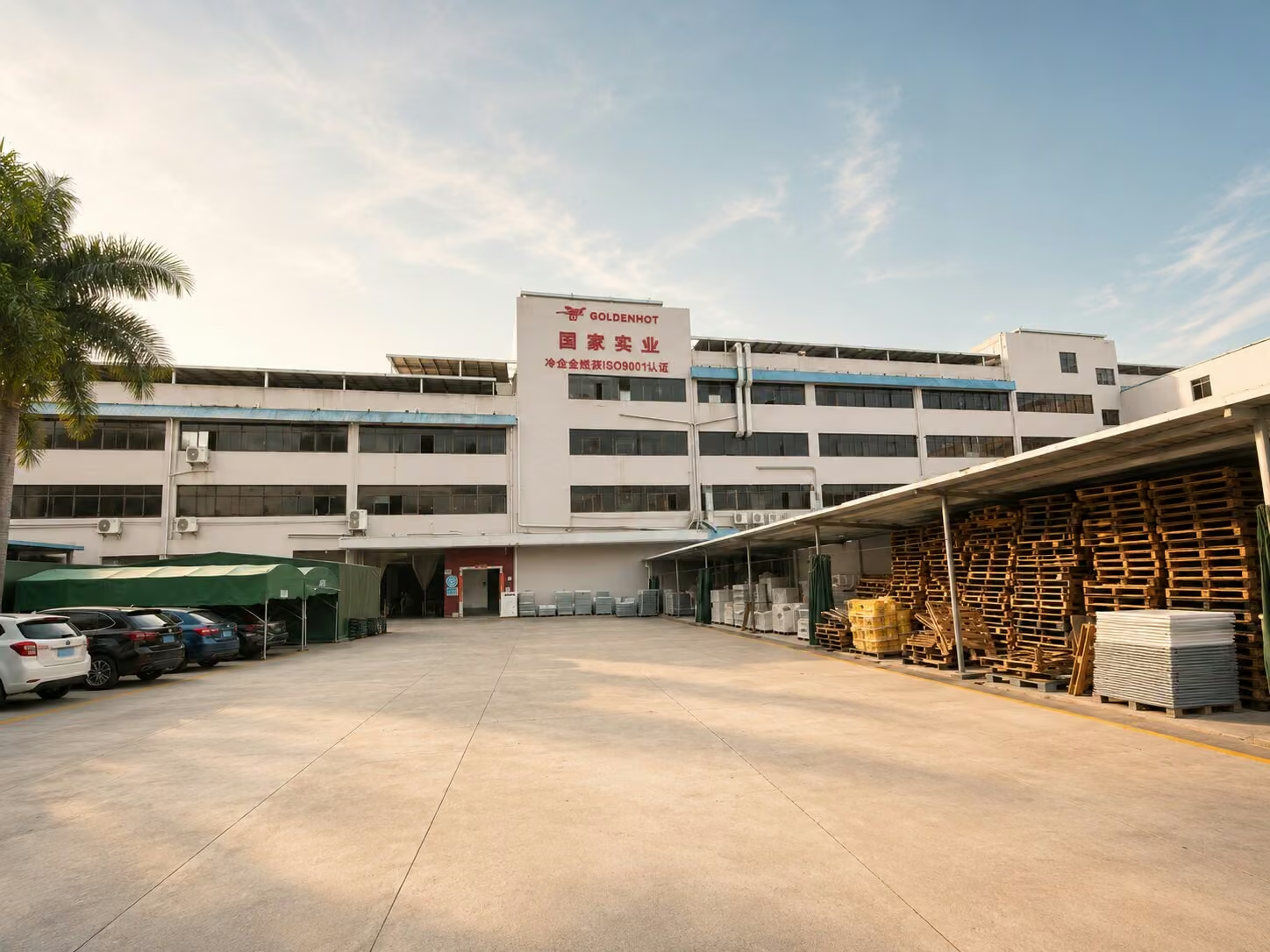
<>GoldHot is the manufacturer, not a trading desk, 20, 000 m² in Houjie, Dongguan, established 2009, 350+ on the floor, 28 SKUs across the catalogue, shipping to 30 markets. Specifically, the export team handles bilingual documentation, FOB and CIF quotes, HTS classification support, and direct engineering Q&A. Meanwhile, the certificates, ETL, UL, CE, FCC, PSE diamond, UKCA, are all issued in our company name and available against the production batch. For any importer running the towel warmer china factory direct comparison, the Dongguan team will return a landed-cost quote and lead time within a working day. Sample turn is 7 to 14 days; production is 25 to 35 days against a 200-unit MOQ.
- <2>Frequently asked questions
<3>How much cheaper is buying towel warmers factory direct from China? <>Roughly 12 to 22 percent at the per-unit level, 12 to 18 percent on stock SKUs, up to 22 percent on custom OEM work. On a 1, 000-unit order of standard rails, that is US$10, 000 to US$18, 000 saved against buying through a trading desk.
<3>Can a small importer buy from a Chinese towel warmer factory directly?
<>Yes. The towel warmer china factory direct path opens at 200 units per SKU, which is GoldHot's standard MOQ. Below that, a trading company that aggregates across buyers may be the only route.
<3>How do I find a real Chinese towel warmer factory?
<>Check the business license for manufacturing scope, request a live video walk of the production line, confirm certificates are issued in the supplier's own company name, and verify the registered factory address in the national enterprise credit system.
<3>What is the MOQ for direct factory orders?
<>Two hundred units per SKU is the typical Dongguan factory MOQ in 2026. Below that the per-unit price climbs sharply because the line setup, raw material order, and QC overhead are the same as for 1, 000 units.
<2>The direct route, from Dongguan