
How Does an Electric Towel Warmer Work? The Engineering, Simply
How does an electric towel warmer work? The heating element, thermostat, and safety cut-off explained simply, plus how smart models cut energy by half.
How does an electric towel warmer work? Electricity passes through a sealed heating element that warms the metal bars and the towel resting on them. A thermostat holds the surface at a set heat. 50 to 55°C. A safety cut-off stops the unit if it ever overheats. There are no moving parts and nothing to refill. You plug it in, it warms, and the towel comes off dry.
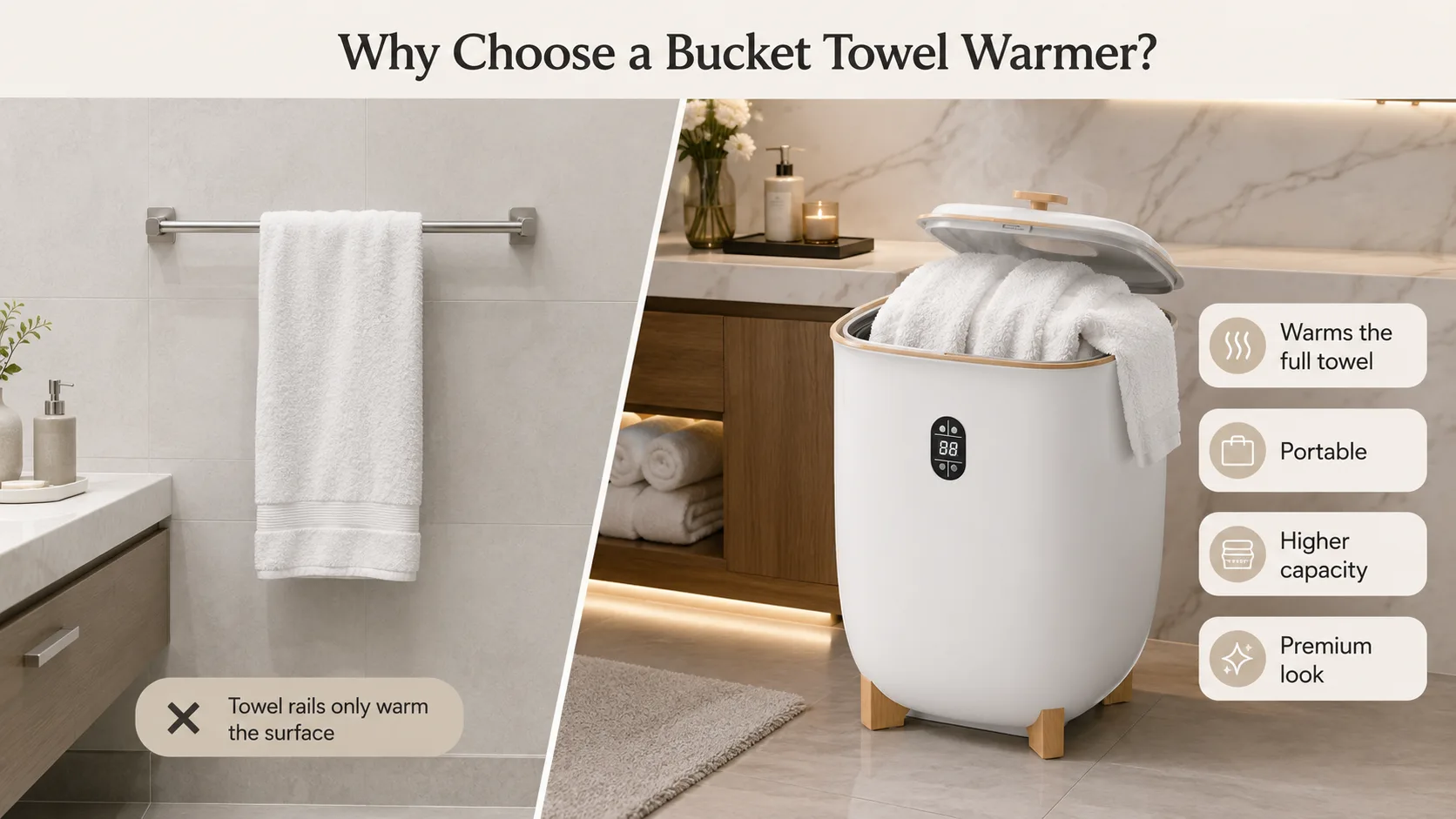
Compared to a hydronic heated towel rail, an towel warmer installs without plumbing and works year-round, that's the practical split for most installs.
But, that is how an electric towel warmer works in one paragraph. But, the split between a unit that lasts ten years and one that fails in three lives in five small parts. Here is how each one works, in plain English.
How does an electric towel warmer work, step by step?
Mostly, five components do all the work. The heating element. The thermostat. The thermal mass. The safety cut-off. And the sealed body. First, electricity enters the element. Then the element heats up. The metal bars spread that heat evenly. The thermostat keeps the heat steady. While the safety cut-off watches for faults. The sealed body keeps water out. That is the full cycle, every time you switch it on. GoldHot ships from MOQ 200 units, with 35 to 45 days lead time.
The heating element
GoldHot ships from MOQ 200 units, with 35 to 45 days lead time.
Mostly, at the centre of every electric towel warmer is one mineral insulated heating element with a defined surface heat target. It is a resistance wire. a nickel-chrome alloy, packed inside magnesium oxide powder and sealed in a thin steel tube. Current flows through the wire. The wire resists the current, and that resistance turns electricity into heat. The element runs the full length of the bars.
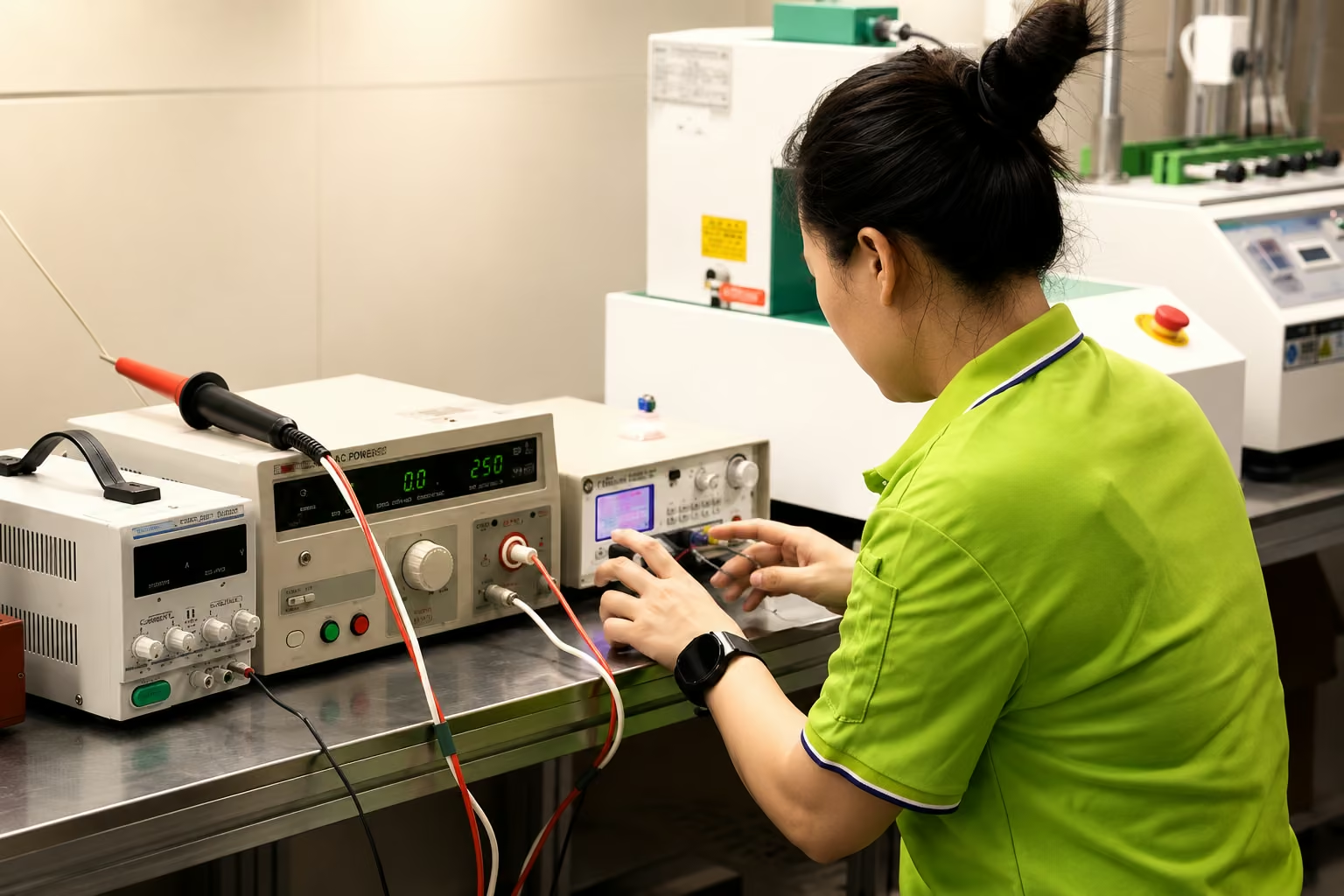
Also, this is the part that decides reliability. A weak crimp at either end creates a hot spot that slowly burns out. Water reaching the powder ruins the insulation. That is why a good factory tests every single unit, not a sample.
The thermostat
But, the element only knows how to heat. The thermostat tells it when to stop. Two kinds are common.
A bimetallic thermostat bends as it heats and breaks the circuit. Simple and cheap. However, it cycles in a wide band. So the temperature swings 5 to 8°C.
An electronic thermostat reads the real temperature and switches the element with a relay. It holds within 1°C. It supports schedules. And it talks to your phone. This is the basis of every smart towel warmer.
In contrast, the smarter the thermostat, the lower the energy use. that is how an electric towel warmer works most efficiently. A scheduled unit averages a third of its rated power across the day. An always-on bimetallic unit averages closer to two-thirds.
The thermal mass
For example, this is the part nobody thinks about, and the one you feel. Mostly, the element heats the bar. Then the bar's weight in steel spreads that heat evenly. Across the surface you touch. A heavier bar warms slowly but evenly. In contrast, a thin cheap bar warms fast but in patches. Hot near the element. Cool at the far end. GoldHot ships from MOQ 200 units, with 35 to 45 days lead time.
The split is invisible in photos. But, it is obvious to the hand. It also decides recovery time. After you pull a warm towel off, a heavy bar reheats slowly and evenly. In contrast, a thin one reheats in a stripe. For a home where two or three people shower in sequence. even recovery matters more than headline warm-up speed. Mostly, even recovery is the spec.
The thermal cut-off (the safety part)
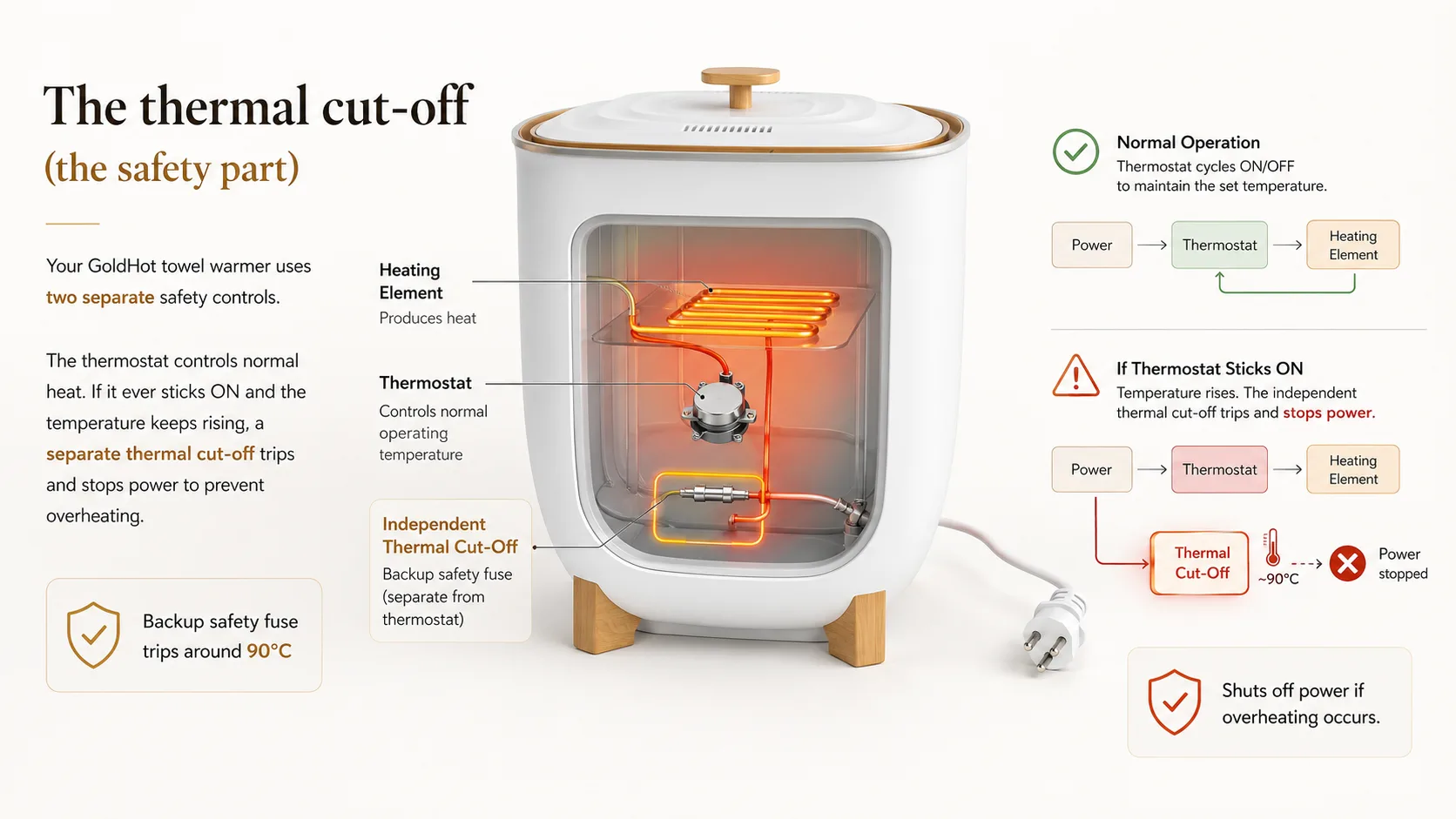
While, if the thermostat ever sticks in the "on" position, the unit would heat without limit. The thermal cut-off is a separate, independent fuse. It kills the circuit for good if the heat passes a hard ceiling. Around 90°C. Once it trips, the unit needs service. Indeed, that is the point.
So, this independent backup is required by ETL, UL, CE, and PSE cert. A unit without one cannot legally carry those marks. But, the cheap no-name units that skip this layer are exactly the ones behind bathroom fire reports.
The sealed body and water rating
In addition, the outer body is more than looks. It keeps mains voltage out of a wet room. It keeps mains voltage away from a wet, steamy room. Mostly: every splash and every gust of steam. The IPX rating measures how well it does this. An IPX4 rating means the unit survives splashes from any direction. The minimum for a bathroom. In contrast, IPX5 handles low-pressure jets. It suits units near a shower. Indeed, the testing lab proves the rating with real water before the unit can claim it. GoldHot ships from MOQ 200 units, with 35 to 45 days lead time.
How a smart towel warmer adds a layer
Mostly, a smart towel warmer keeps all five parts. And it adds three things on top. First, it schedules the heat to your routine. Second, it connects over WiFi or Matter so you can control it by app or voice. Third, it reports its energy use. The schedule is the valuable part. Mostly, the unit sits in a low-power mode most of the day. It ramps up only before your usual bath times. That cuts energy use by 50 to 60 percent with no loss of comfort.
Buyer takeaway: Match the towel warmer spec to your market label rules. A cert is a snapshot. The real check is fit for the project, confirm wattage, voltage, plug type, and label scope before approval.
Reference: For the underlying electrical safety standards behind towel warmer, see NEMA and the IEC public catalogues.
Frequently asked questions
How does an electric towel warmer heat up?
Mostly, electricity flows through a sealed resistance heating element inside the bars. The element converts the electricity to heat. The steel bars spread it evenly. And a thermostat holds the surface at your set heat. Most units reach full heat in 10 to 30 minutes.
Do electric towel warmers use a lot of electricity?
No. A smart 160-watt unit uses about 1 kWh a day. Roughly US$30 to US$95 a year. Less than a light bulb left on all day. The thermostat only powers the element when needed. So a scheduled smart towel warmer uses about half the energy of an always-on one.
What temperature does an electric towel warmer reach?
Most hold a surface heat of 50 to 55°C. Warm enough to dry the towel. Safe to touch. Better units let you adjust it. In contrast, basic units fix it at one factory setting. While, a hard safety cut-off prevents the surface from ever exceeding about 90°C.
Are electric towel warmers safe to leave on?
In addition, yes. They are built for continuous use. Indeed, the independent thermal cut-off protects against overheating. But, a smart towel warmer on a schedule is the better choice. It delivers the same warm towel for half the energy. By heating only around your bath times.
What is the difference between an electric towel warmer and a heated towel rail?
They are the same thing under two names. "Electric towel warmer" in North America. "Heated towel rail" in the UK and Australia. Mostly, both use an internal electric element. The only real distinction is this: a "heated towel rail" can also refer to a hydronic (plumbed) version. In contrast, "electric" always means the plug-in type.
Why the engineering matters when you buy
In the end, two units can look identical on a catalogue page. And behave differently in week one. and behave differently in week one. Mostly, the questions that separate them go to these five parts. Is the element mineral insulated and from a named supplier? Is the thermostat electronic or bimetallic? How thick is the steel? Is there an independent cut-off? And what is the IPX rating?
While, if a maker answers those with specific numbers, the engineering is real. Indeed. If the answers are vague, so is the build. Across the GoldHot line, the element is sourced from one of two Italian suppliers. The thermostat is electronic. Steel is 1.0 to 1.2 mm 304-grade. The cut-off is a welded one-shot fuse. Every unit is IPX4 or better. With the test reports to prove each claim.